Dessy Ekawati1*, Agustina Maunaturrohmah1, Anin Wijayanti1, Ifa Nofalia2
- Professional Nursing Program, Faculty of Health Sciences, Institut Teknologi Sains dan Kesehatan Insan Cendekia Medika, Jombang, Indonesia.
- Bachelor Nursing Program, Faculty of Health Sciences, Institut Teknologi Sains dan Kesehatan Insan Cendekia Medika, Jombang, Indonesia.
* Corresponding author: Dessy Ekawati., Professional Nursing Program, Faculty of Health Sciences, Institut Teknologi Sains dan Kesehatan Insan Cendekia Medika, Jombang, Indonesia.
E-mail: dessyekawati.s1201@gmail.com
Cite this article
ABSTRACT
Introduction: Non-Suicidal Self-Injury (NSSI) has become an increasing mental health concern among adolescents and is strongly associated with negative cognitive–emotional states, particularly hopelessness. Adolescents experiencing hopelessness are more vulnerable to engaging in maladaptive coping behaviors, including self-injury.
Objective: This study aimed to examine the relationship between hopelessness and NSSI and to determine the role of hopelessness as a predictor of self-injurious behavior among adolescents.
Materials and Methods: This study employed a quantitative cross-sectional design involving 138 senior high school students aged 15–19 years selected using stratified random sampling. Hopelessness was measured using the Beck Hopelessness Scale (BHS), while Non-Suicidal Self-Injury (NSSI) was assessed using the Inventory of Statements About Self-Injury (ISAS). Data were analyzed using Spearman’s rank correlation test to determine the relationship between variables.
Results: The findings revealed that most respondents experienced moderate levels of hopelessness (40.6%) and mild levels of NSSI (59.4%). Statistical analysis showed a significant very strong positive correlation between hopelessness and NSSI (r = 0.876; p-value < 0.001), indicating that higher levels of hopelessness were associated with increased frequency and severity of self-injurious behavior.
Conclusion: The results indicate that hopelessness plays a significant role in the development of NSSI among adolescents. Adolescents with higher levels of hopelessness tend to have poorer emotional regulation and are more likely to engage in self-injury as a coping mechanism. These findings highlight the importance of early identification of hopelessness in adolescents and the need for targeted mental health nursing interventions to reduce the risk of Non-Suicidal Self-Injury (NSSI).
Keywords: Adolescents; Hopelessness; NSSI; Mental health; Self-injury
INTRODUCTION
Non-Suicidal Self-Injury (NSSI) has emerged as one of the most concerning mental health problems among adolescents. This behavior is no longer viewed as a transient or incidental phenomenon, but rather as a significant psychological response to prolonged emotional distress and internal conflict [1]. Adolescence is a developmental period characterized by identity formation, emotional instability, and interpersonal challenges, which increases vulnerability to maladaptive coping strategies such as self-injury. Non-Suicidal Self-Injury (NSSI) is often used as a means to regulate overwhelming emotions, reduce psychological pain, or cope with feelings of emptiness and helplessness. Clinically, NSSI manifests through intentional tissue damage such as cutting, burning, or scratching without suicidal intent. This characteristic distinguishes it from suicidal self-injury where the primary goal is to end one’s life. Unlike suicidal behavior, NSSI often serves as a maladaptive affect regulation strategy to relieve intense psychological tension. If left unaddressed, this behavior may persist and increase the risk of more severe mental health problems, including suicidal behavior [2].
Globally, the prevalence of Non-Suicidal Self-Injury (NSSI) among adolescents ranges from 10% to 35%, with higher rates reported in individuals aged 15–19 years. Studies conducted in Europe and North America indicate that approximately 17–24% of adolescents have engaged in at least one form of self-injurious behavior, while in several Asian countries the prevalence exceeds 30% [3]. In Indonesia, national data indicate that emotional and mental health problems among adolescents aged 15–24 years have increased significantly, reaching more than 20%, accompanied by a growing trend of self-harm behavior and suicidal ideation [4]. These findings highlight the urgency of addressing Non-Suicidal Self-Injury (NSSI) as a major public health concern.
Various psychological factors have been associated with Non-Suicidal Self-Injury (NSSI), including depression, anxiety, emotional dysregulation, trauma, and cognitive distortions. Among these, hopelessness is considered a central cognitive–affective factor [5]. Hopelessness reflects negative expectations about the future, a loss of meaning in life, and the belief that current difficulties will not improve. In adolescents, this condition may arise from academic stress, family conflict, bullying, and social rejection [6]. Previous studies have shown that hopelessness is strongly associated with depressive symptoms, increased risk of self-injury, and progression toward suicidal ideation. It also contributes to impaired social functioning, decreased academic performance, and withdrawal from social interactions [7].
From a nursing perspective, hopelessness represents a critical psychosocial problem that affects an individual’s motivation, coping ability, and overall well-being. Nurses play a pivotal role in early detection, yet many professionals, particularly in school settings, report challenges in distinguishing subtle signs of NSSI and hopelessness due to a lack of specialized psychiatric training. In the Indonesian context, the presence of dedicated school nurses to assess and manage student mental health is still limited, with responsibilities often falling to general health teachers or school counselors. Nursing interventions that focus on enhancing hope, restructuring negative cognitions, and strengthening adaptive coping strategies are essential in preventing Non-Suicidal Self-Injury (NSSI). However, effective intervention strategies require strong empirical evidence regarding the role of hopelessness and its association with self-injurious behavior among adolescents [8].
Objective
This study aims to examine the relationship between hopelessness and Non-Suicidal Self-Injury (NSSI) among adolescents and to analyze the strength and direction of the association between these two variables using a cross-sectional approach.
MATERIALS AND METHODS
Study Population
This research employed a cross-sectional study design to investigate the relationship between hopelessness and Non-Suicidal Self-Injury (NSSI) behavior. The study was conducted across three selected Senior High Schools in Jombang Regency, East Java, Indonesia, during the period of February to March 2026. A total of 138 adolescents were recruited as participants through a stratified random sampling technique, with strata defined by grade levels (Grades X, XI, and XII) across the selected schools. The sample size was determined using the G*Power 3.1.9.7 software for a correlation bivariate model with an effect size of 0.3 which represents a medium effect, an alpha level of 0.05, and a power of 0.95. These parameters yielded a minimum required sample of 134 participants, therefore the 138 participants included in this study provided sufficient statistical power. The research protocol was strictly guided by the ethical principles of the Declaration of Helsinki and received formal approval from the Health Research Ethics Committee of the Faculty of Health, Institut Teknologi Sains dan Kesehatan (ITSKes) Insan Cendekia Medika Jombang on January 12, 2026, with the issuance of protocol number KEPK/ICME/031/I/2026.
Inclusion criteria
The participants eligible for this study were limited to adolescents aged 15–19 years who were actively enrolled as students in the participating schools at the time of data collection. Inclusion also required a demonstrated willingness to participate in the research, which was confirmed by the submission of signed informed consent forms. Furthermore, participants were required to be capable of understanding and completing the research questionnaires independently without external assistance. For participants under 18 years old, additional written consent was obtained from their parents or legal guardians.
Exclusion criteria
The study excluded adolescents who had a documented medical history of severe psychiatric disorders, such as schizophrenia or bipolar disorder, as well as those currently undergoing intensive psychological or psychiatric therapy. To ascertain these exclusion criteria, the research team conducted a two-step verification process. This involved reviewing students’ confidential health records in collaboration with school counselors and performing brief clinical screening interviews prior to enrollment to identify any overt signs of psychotic symptoms or cognitive impairment. Additionally, students who withdrew their participation at any point during the data collection process or those who provided incomplete responses to the instruments were also excluded from the final analysis.
Data Collection Procedure
Data collection was carried out in a designated quiet room within each school to ensure participant privacy and confidentiality. The researchers first explained the study purpose and the voluntary nature of participation. Once consent was secured, participants completed a sociodemographic questionnaire followed by the BHS and ISAS scales. The sociodemographic questionnaire included items regarding age, gender, grade level, living arrangements, and a specific self-report question asking whether they had ever experienced significant emotional problems in the past. The entire process took approximately 20-30 minutes per student. To ensure language comprehension, a researcher was present throughout the session to clarify any confusing terminology even though the instruments had already been pilot-tested for clarity.
Instruments
Data were collected using two primary instruments that underwent a rigorous forward-back translation process into the Indonesian language to maintain linguistic and cultural equivalence. The instruments used in this study are widely recognized in the public domain for academic and research purposes. Hopelessness was measured using the Beck Hopelessness Scale (BHS) developed by Beck et al. (1974) consisting of 20 true or false items that evaluate negative expectations about the future. In this study, the Indonesian version of the BHS demonstrated high internal consistency with a Cronbach’s alpha of 0.88. Non-Suicidal Self-Injury (NSSI) was assessed using the Inventory of Statements about Self-Injury (ISAS) adapted from Nock et al. (2010) which measures the frequency and psychological functions of self-injurious behaviors. The Indonesian adaptation of the ISAS was specifically validated for this study and yielded a Cronbach’s alpha of 0.84. Prior to the main data collection, a pilot study was conducted with 30 adolescents in a similar demographic area to ensure the terminology was easily understood by the target population. This section also included the collection of sociodemographic variables such as age, gender, and family structure which are subsequently reported in the results.
Statistical analysis
The collected data were processed and analyzed using IBM SPSS Statistics version 26.0. Descriptive statistics were utilized to summarize the demographic characteristics and profiles of the participants. To determine the strength and direction of the association between hopelessness and Non-Suicidal Self-Injury (NSSI), the Spearman rho rank correlation test was performed utilizing a two-tailed test. This choice was justified considering that the data were not normally distributed, as confirmed by the Kolmogorov-Smirnov normality test, and the variables were ordinal in nature. For all statistical tests in this study, a p-value < 0.05 was considered statistically significant.
RESULTS
Sample Characteristics
Based on Table 1, the characteristics of the respondents show that out of 138 students, the largest age group was 16 years old with 42 students (30.4%), followed by those aged 17 years with 39 students (28.3%), 15 years with 28 students (20.3%), 18 years with 21 students (15.2%), and 19 years with 8 students (5.8%). The mean age of the respondents was 16.7 years with a standard deviation of 1.02. In terms of gender, female students predominated, accounting for 77 respondents (55.8%), while male students numbered 61 (44.2%).
Regarding grade level, most participants were in Grade XI with 49 students (35.5%), followed by Grade X with 46 students (33.3%) and Grade XII with 43 students (31.2%).
Concerning living status, the majority of respondents lived with their parents (102 students; 73.9%), whereas 21 students (15.2%) lived with relatives and 15 students (10.9%) resided in a boarding school or dormitory.
With respect to the history of emotional problems, 80 respondents (58.0%) reported having experienced emotional problems, while 58 respondents (42.0%) reported none.
Characteristics N % Mean SD Age (years) 15 years 28 20.3 16.7 1.02 16 years 42 30.4 17 years 39 28.3 18 years 21 15.2 19 years 8 5.8 Gender Male 61 44.2 Female 77 55.8 Grade Grade X 46 33.3 Grade XI 49 35.5 Grade XII 43 31.2 Living Status With parents 102 73.9 With relatives 21 15.2 Boarding school/dormitory 15 10.9 History of Emotional Problems Yes 80 58.0 No 58 42.0 Table 1. Sociodemographic Characteristics of Respondents (N = 138).
Descriptive Analysis of Hopelessness and Non-Suicidal Self-Injury (NSSI)
The distribution of hopelessness levels shows that the majority of respondents fell into the moderate category (N = 68; 49.3%), followed by mild and high levels (N = 24 for each; 17.4%), while the remaining students reported low levels (N = 22; 15.9%).
Regarding Non-Suicidal Self-Injury (NSSI), nearly half of the participants were categorized as having a moderate frequency (N = 66; 47.8%), followed by low frequency (N = 41; 29.7%), no Non-Suicidal Self-Injury (NSSI) (N = 18; 13.0%), and high frequency (N = 13; 9.4%).
Characteristics N % Mean SD Hopelessness Level Low 22 15.9 2.68 0.944 Mild 24 17.4 Moderate 68 49.3 High 24 17.4 Non-Suicidal Self-Injury (NSSI) Category No NSSI 18 13.0 2.54 0.838 Low frequency 41 29.7 Moderate frequency 66 47.8 High frequency 13 9.4 Table 2. Distribution of Hopelessness Levels and NSSI Categories (N = 138).
Correlation Between Hopelessness and Non-Suicidal Self-Injury Among Adolescents
To determine the relationship between hopelessness and Non-Suicidal Self-Injury (NSSI), a Spearman rank correlation test was performed. As shown in Table 3, the results indicate a positive and statistically significant relationship between the two variables, with a correlation coefficient of r = 0.876 and a p-value < 0.001. This very strong correlation suggests that as the level of hopelessness increases, the frequency of Non-Suicidal Self-Injury (NSSI) behaviors among adolescents also significantly increases.
Variable M (SD) Median (IQR) Sig. (2-tailed) Spearman Correlation Hopelessness 10.27 (5.05) 11 [6.00, 14.00] Correlation coefficient r = 0.876, p < 0.001* NSSI 10.24 (7.64) 11 [3.75, 15.00] Note: *=significant test, SD = standard deviation, IQR = interquartile range [Q1, Q3].
Table 3. Spearman Correlation Analysis of Hopelessness and NSSI (N = 138)
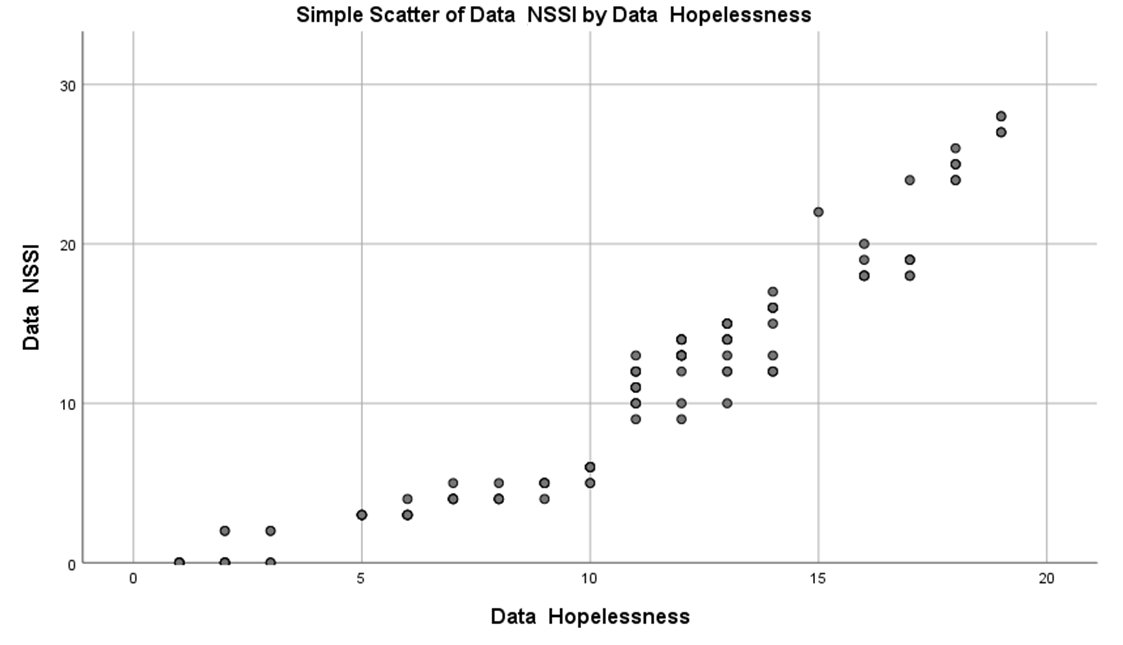
Figure 1 presents a scatter plot illustrating the correlation between hopelessness scores and Non-Suicidal Self-Injury (NSSI) frequency among adolescents. The visual distribution of data points reveals a consistent upward linear pattern, where an increase in hopelessness scores is accompanied by a rise in Non-Suicidal Self-Injury (NSSI) scores. The analysis confirms a very strong positive correlation between these two variables (r = 0.876, p-value < 0.001), indicating that higher levels of hopelessness are significantly associated with higher levels of Non-Suicidal Self-Injury (NSSI) behavior. This strong linear relationship underscores the critical role of hopelessness as a psychological factor in self-injurious actions.
Figure 1. Scatter plot showing the correlation between hopelessness and NSSI.
The crosstabulation analysis further illustrates the distribution of respondents based on hopelessness levels and Non-Suicidal Self-Injury (NSSI) categories. Among respondents with moderate levels of hopelessness, the majority were categorized as having moderate frequency Non-Suicidal Self-Injury (NSSI) (55 students), while 13 students were in the low frequency category, totaling 68 individuals. In contrast, respondents with severe hopelessness were mostly distributed in the moderate frequency (11 students) and high frequency Non-Suicidal Self-Injury (NSSI) categories (13 students), totaling 24 individuals.
For those with mild hopelessness, all respondents were categorized in the low frequency Non-Suicidal Self-Injury (NSSI) group (24 students). Meanwhile, among respondents with low hopelessness, most reported no NSSI behavior (18 students), while a smaller proportion fell into the low frequency category (4 students), totaling 22 individuals (Table 4).
Hopelessness Non-Suicidal Self-Injury (NSSI) Total No Low frequency Moderate frequency High frequency Low 18 4 0 0 22 Mild 0 24 0 0 24 Moderate 0 13 55 0 68 High 0 0 11 13 24 Total 18 41 66 13 138 Table 4. Crosstabulation of Hopelessness and Non-Suicidal Self-Injury.
DISCUSSION
Based on the respondents’ characteristics, the largest age group was 16 years old (42 students; 30.4%), with a mean age of 16.7 ± 1.02 years, representing the middle-adolescent developmental stage. According to Erikson’s psychosocial theory, this stage corresponds to the phase of identity versus role confusion, in which adolescents are highly sensitive to academic pressure, peer relationships, and identity exploration, making them more vulnerable to emotional distress and feelings of hopelessness [9].
The predominance of female students (77 students; 55.8%) is consistent with previous findings indicating that adolescent girls are more likely to experience internalizing problems, including hopelessness and self-injurious behavior, than boys [1,2]. Most respondents were in Grade XI (49 students; 35.5%), a period characterized by increasing academic demands and future-related concerns, which, according to developmental stress theory, may intensify psychological strain.
The majority of participants lived with their parents (102 students; 73.9%), suggesting that hopelessness and self-injury can occur not only among adolescents separated from their families but also within intact family settings, depending on the quality of emotional support. Furthermore, more than half of the respondents reported a history of emotional problems (80 students; 58.0%), supporting the diathesis–stress model, which posits that pre-existing psychological vulnerability increases the risk of maladaptive emotional responses under stress [5].
The distribution of hopelessness levels showed that the moderate category was the most prevalent (68 students; 49.3%), with a mean score of 10.27 ± 5.05. This finding indicates that a substantial proportion of adolescents experienced pessimistic expectations about the future and a reduced sense of control over life outcomes. According to Beck’s cognitive theory, hopelessness arises from negative cognitive schemas and distorted beliefs about the self, the world, and the future, which are particularly salient during adolescence when individuals face academic, interpersonal, and identity-related challenges [10,11]. Similar patterns have been reported, showing that moderate levels of hopelessness are common in adolescents and constitute an important risk factor for emotional and behavioral problems, including self-injury [12,13]. From a psychiatric nursing perspective, these moderate levels of hopelessness necessitate early identification and cognitive interventions to prevent the development of more severe psychological crises.
Regarding Non-Suicidal Self-Injury (NSSI), the largest proportion of respondents fell into the moderate frequency category (66 students; 47.8%), followed by low frequency (41 students; 29.7%). A smaller proportion reported no NSSI behavior (18 students; 13.0%), while only 13 students (9.4%) were categorized as having high frequency NSSI. The mean NSSI score was 10.24 ± 7.64. This finding suggests that many adolescents engage in self-injurious behavior at a moderate level, which may reflect repeated use of Non-Suicidal Self-Injury (NSSI) as a coping mechanism rather than isolated incidents. In line with Nock’s (2010) functional model of Non-Suicidal Self-Injury (NSSI), such behaviors primarily serve an affect-regulation function, helping individuals manage intense negative emotions such as sadness, anger, emptiness, or psychological tension [14]. This result is also consistent with previous studies indicating that Non-Suicidal Self-Injury (NSSI) behaviors in adolescents often begin at lower or moderate frequencies and may escalate if underlying emotional distress is not adequately addressed [15].
The correlation analysis revealed a statistically significant and very strong positive relationship between hopelessness and NSSI (r = 0.876; p-value < 0.001), with median scores and Interquartile Ranges (IQR) of 11 (8) and 11 (11) respectively. This result supports the hopelessness theory, which emphasizes that negative expectations about the future and a sense of futility can lead individuals to adopt maladaptive coping behaviors, including self-injury [13]. The present findings are also in accordance with previous studies, which identified hopelessness as a significant predictor of Non-Suicidal Self-Injury (NSSI) among adolescents [8,16]. Clinically, this very strong correlation indicates that higher levels of hopelessness are closely associated with greater tendencies and severity of self-injurious behavior, highlighting the importance of assessing hopelessness as a key risk indicator in adolescent mental health and psychiatric nursing practice. Consequently, it is imperative for nursing professionals to integrate hopelessness screening into routine adolescent health assessments, focusing on fostering hope and resilience to mitigate the risk of self-injurious behaviors.
CONCLUSION
This study shows a significant and very strong positive relationship between hopelessness and Non-Suicidal Self-Injury (NSSI) among adolescents. Adolescents with higher levels of hopelessness tend to exhibit higher frequency and severity of self-injurious behavior. These findings indicate that negative expectations about the future and feelings of helplessness play a crucial role in the development of maladaptive coping strategies, particularly Non-Suicidal Self-Injury (NSSI).
The predominance of moderate levels of hopelessness and moderate frequency of Non-Suicidal Self-Injury (NSSI) suggests that emotional distress and self-injurious behavior are already present at a considerable level among adolescents. This highlights the importance of early identification and intervention within school settings.
Assessing hopelessness as a key psychological risk factor is essential in mental health screening and psychiatric nursing practice. Interventions focusing on enhancing hope, strengthening positive future orientation, and promoting adaptive coping strategies are necessary to prevent the escalation of self-injurious behavior and to improve adolescents’ psychological well-being.
Limitations
This study has several limitations. First, the use of a cross-sectional design does not allow for causal conclusions between hopelessness and Non-Suicidal Self-Injury (NSSI). Second, the data were collected using self-report questionnaires, which may be subject to response bias and social desirability, especially given the sensitive nature of self-injurious behavior. Third, although this study involved three different schools, the findings may still have limited generalizability to adolescents in diverse geographical or cultural contexts beyond the study area. Fourth, this study did not control for potential confounding variables, such as symptoms of depression or anxiety, which are known to be significantly associated with both hopelessness and NSSI behavior.
Despite these limitations, this study has notable strengths, including the use of instruments (BHS and ISAS) that have been culturally adapted and validated for the Indonesian adolescent population. Furthermore, the sample size (N = 138) is robust and highly adequate for correlational analysis, providing strong statistical power for the identified relationships. The focus on clinically relevant psychological variables contributes to a deeper understanding of adolescent mental health and provides a solid basis for future research and intervention development.
Funding statement
This research did not receive any specific grant from funding agencies in the public, commercial, or not for profit sectors.
Local Ethics Committee approval
This research was approved by the Health Research Ethics Committee of the Faculty of Health, Institut Teknologi Sains dan Kesehatan (ITSKes) Insan Cendekia Medika Jombang on January 12, 2026, with the issuance of protocol number KEPK/ICME/031/I/2026.
Conflict of interest
The authors report no conflict of interest.
Authors’ contribution
Dessy Ekawati (DE) contributed to the conception and design of the study, data collection, data analysis, interpretation of the results, and manuscript drafting.
Agustina Maunaturrohmah (AM) contributed to data collection, data analysis, and critical revision of the manuscript.
Anin Wijayanti (AW) contributed to the study design, supervision, and review of the manuscript.
Ifa Nofalia (IF) contributed to data interpretation and manuscript revision.
All authors read and approved the final version of the manuscript.
Acknowledgements
The author would like to express sincere gratitude to all respondents who participated in this study, as well as to the school authorities for their support and cooperation during the data collection process. Appreciation is also extended to colleagues and mentors who provided valuable input and guidance throughout the research process.
REFERENCES
- Escofet-Colet I, Casadó-Marín LC, Orós-Navas L, Raventós-Torner R. Non‐Suicidal Self‐Injury in Adolescents: A Systematic Review on Prevention and Intervention Programmes. J Child Adolesc Psychiatr Nurs 2025;38:e70039. doi: 10.1111/JCAP.70039.
- Arinda OD, Mansoer WWD. NSSI (Non-suicidal Self-Injury) of emerging adults in Jakarta: An interpretative phenomenological approach. J Psikol Ulayat 2020;8:123–47. doi: 10.24854/jpu150.
- Apicella M, Pontillo M, Maglio G, Di Vincenzo C, Della Santa G, Andracchio E, et al. Non-suicidal self-injury in adolescents: a clinician’s guide to understanding the phenomenon, diagnostic challenges, and evidence-based treatments. Front Psychiatry 2025;16:1605508. doi: 10.3389/FPSYT.2025.1605508.
- Kemenkes RI. Laporan Survei Kesehatan Indonesia (SKI) 2023. Jakarta: Kementerian Kesehatan; 2023.
- Iswanti DI, Lai LL, Saifudin IMMY, Kandar K, Dewi RK, Cahyaningrum DD. The predictor of non-suicidal self-injury behavior among adolescents: a cross-sectional study. J Ners 2024;19:125–33. doi: 10.20473/jn.v19i2.54610.
- Ren T, Wen Y, Ma L, Qiao D, Li G, Li H, et al. Psychosocial factors affect the occurrence of nonsuicidal self-injury in adolescents with major depressive disorder through chain mediation. Eur Arch Psychiatry Clin Neurosci 2024;275:1209. doi: 10.1007/S00406-024-01858-0.
- Ahn C-Y, Kim J-H, Kim S-J, Kim J-W, Na J-J, Seo D-G, et al. The Impact of Negative Emotions on Adolescents’ Nonsuicidal Self-Injury Thoughts: An Integrated Application of Machine Learning and Multilevel Logistic Models. MedRxiv 2025:2025.02.15.25322355. doi: 10.1101/2025.02.15.25322355.
- Zhou J, Hu S, Wu H, Wang S, Gong J. From Thoughts to Actions: A Longitudinal Examination of NSSI Risk Factors in Adolescence. Psychol Res Behav Manag 2025;18:1915–30. doi: 10.2147/PRBM.S545595.
- Erikson EH. Identity: Youth and Crisis. New York: W.W. Norton & Company; 1968.
- Bu X, Gai X, Zhang P, Yu X, Zhang C. Associations between hopelessness, negative thinking styles, and depression in Chinese adolescents: a large-sample cross-sectional study. BMC Psychol 2025 131 2025;13:1228-. doi: 10.1186/S40359-025-03549-4.
- Zaiden F, Mahfar M. Depression among Adolescents: A Review of Beck’s Cognitive Behaviour Theory. J Sains Kesihat Malaysia 2024;22:1–11. doi: 10.17576/JSKM-2024-2201-01.
- Li X, Zhou Y, Liu L. Relationship Between Loneliness, Hopelessness, Coping Style, and Mobile Phone Addiction Among Non-Suicidal Self-Injury Adolescents. Psychol Res Behav Manag 2024;17:3573–84. doi: 10.2147/PRBM.S483528.
- Sanz-Sendra X, Mora-Ascó J, Gallego-Hernández de Tejada B, Marco JH, Pérez Rodríguez S. A Comparative Study of Nonsuicidal Self-Injury, Hopelessness and Meaning in Life Before and After COVID-19 in Adolescents. Clin Psychol Psychother 2024;31. doi: 10.1002/CPP.70003.
- Yu J, Kim MS, Kim M. Non-suicidal self-injury motivation scale in a community sample of adolescents: a methodological study. BMC Psychol 2024 121 2024;12:292-. doi: 10.1186/S40359-024-01795-6.
- Baker AC, Wallander JL, Elliott MN, Schuster MA. Non-Suicidal Self-Injury Among Adolescents: A Structural Model with Socioecological Connectedness, Bullying Victimization, and Depression. Child Psychiatry Hum Dev 2023;54:1190–208. doi: 10.1007/S10578-022-01319-6.
- Faura-Garcia J, Calvete E, Orue I. Longitudinal Associations Between Nonsuicidal Self-Injury, Depressive Symptoms, Hopelessness, and Emotional Dysregulation in Adolescents. Arch Suicide Res 2024;28:800–14. doi: 10.1080/13811118.2023.2237075.
This work is licensed under a Creative Commons Attribution-NonCommercial-NoDerivatives 4.0 International License.